
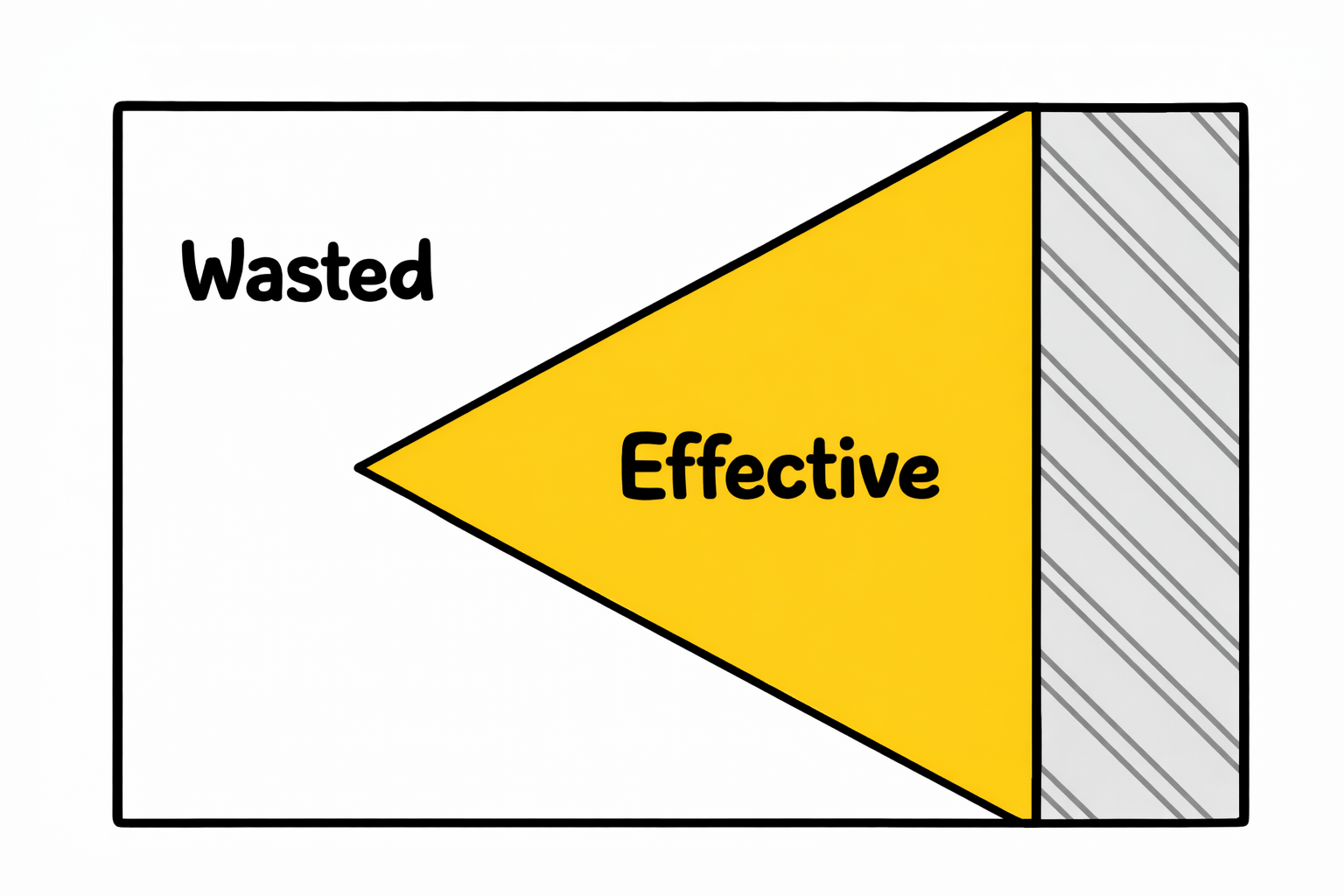
When we picture how explosives do work, we often picture blast propagation passing through the material in a nice linear way. Of course, we recognise that some of the gas products are exiting at the sides, but we typically do not try and account for these losses in our calculations of explosive effects.
For an unconfined explosive, these gases escaping to the sides are doing no work on the target and hence they need to be discounted for a precise understanding of the effects. Fortunately the experiments have already been done and it turns out that that there is a “cone” of effective explosive mass of 60°. What this means is that the configuration of explosives make a big difference: stack too high or too wide and you may be wasting explosive. The figures below show two cases of unconfined explosive driving a flyer plate:
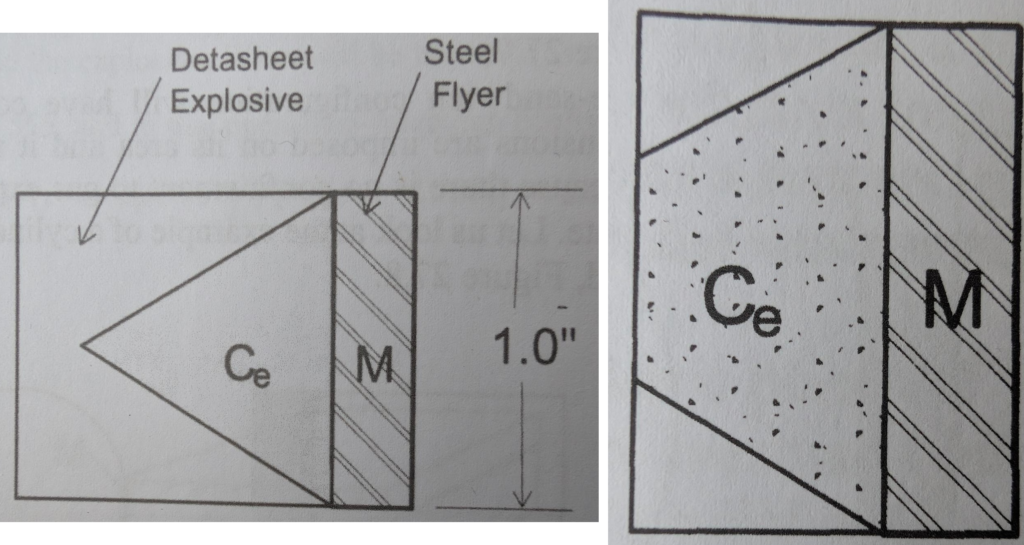
In the figure on the left, there is a thick layer of sheet explosive which exceeds the cone (or triangle in this 2D image) of effective explosive mass labelled \( C_{e} \). On the right, the explosive is not thick enough to create the maximum possible effective charge mass and is instead a truncated cone.
The obvious takeaway of this is to shape charges in such a way that best approximates this effective charge cone or to confine the explosives such that there are minimal side losses.
Leave a Reply