Category: Detection

  • Seeing Beyond the Visible: Hyperspectral Imaging

    Seeing Beyond the Visible: Hyperspectral Imaging

    Not everything is easy to see. Some things are actively trying to hide whilst others are just hard or impossible to see with the naked eye. What we would like is a tool that enhances our ability to see beyond the visible spectrum. Even better if we can recognise what it is we are looking at.

    Thermal optics do that by allowing us to see into the infrared part of the spectrum. By treating everything like a black body, we can even estimate the temperature of different things that are being imaged and highlight things like humans for ease of recognition. Often to do that we sacrifice the visual spectrum or have to superimpose it with a fused view.

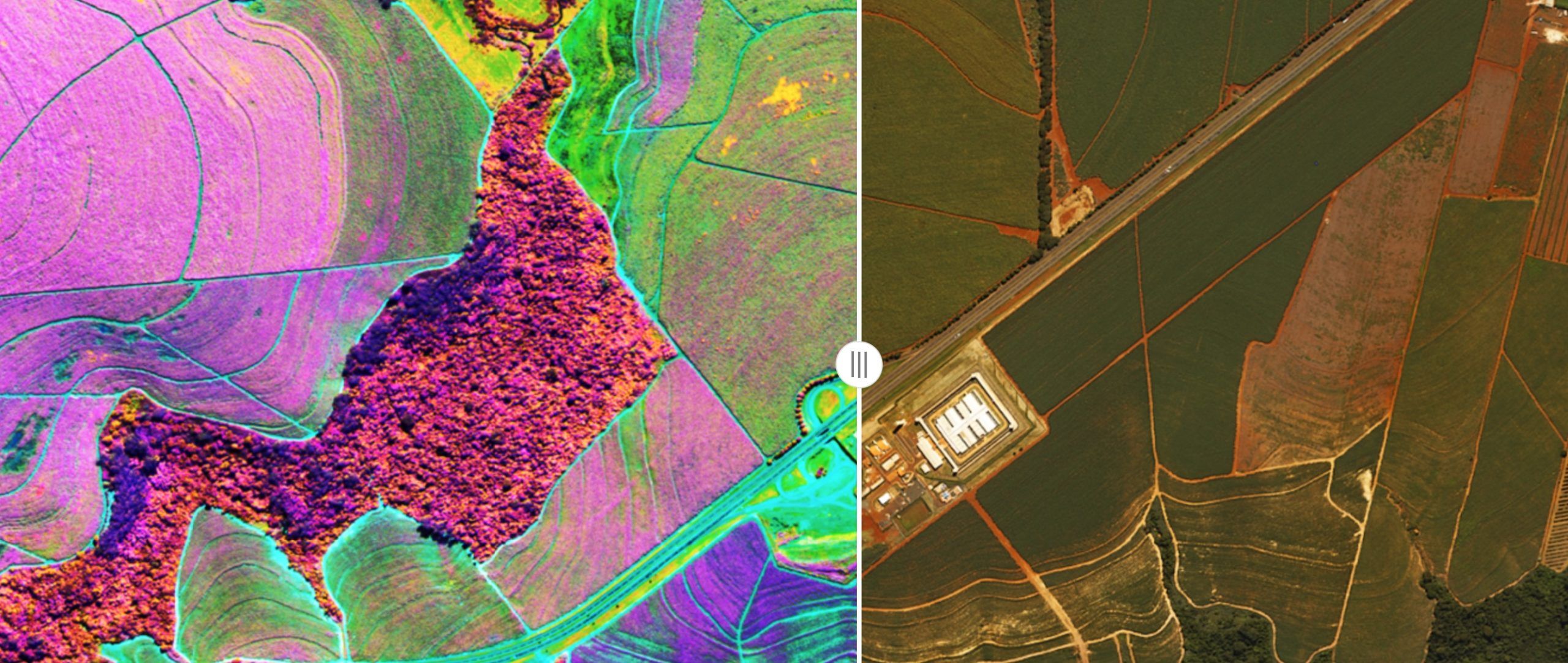
    Hyperspectral imaging (HSI) goes several steps further. Where a normal camera would give you how much red, green, and blue are in each pixel in an image, and an IR camera might give you some channels in the infrared, HSI gives you detail into the whole spectrum of its range down to bands of a few nanometres.

    This phenomenal amount of data means you have what is essentially an FTIR spectrum (like you would get from a commonly used TruDefender from Thermofisher) for each pixel in an image. Much like you would use an FTIR spectrum, that means you can start to understand the material of anything you image with a HSI system.

    For the CBRNE world that means a few things. First, we might be able to use them to detect things that are camouflaged in the visible part of the spectrum. The famous Houthi roadside IEDs that were hidden as rocks would have a wildly different spectral fingerprint compared to a real rock. I have never scanned a rock, but it strikes me as the kind of thing with different functional groups to the polyurethane of expanding foam. The right kind of anomaly detection algorithm would make detecting those very easy.
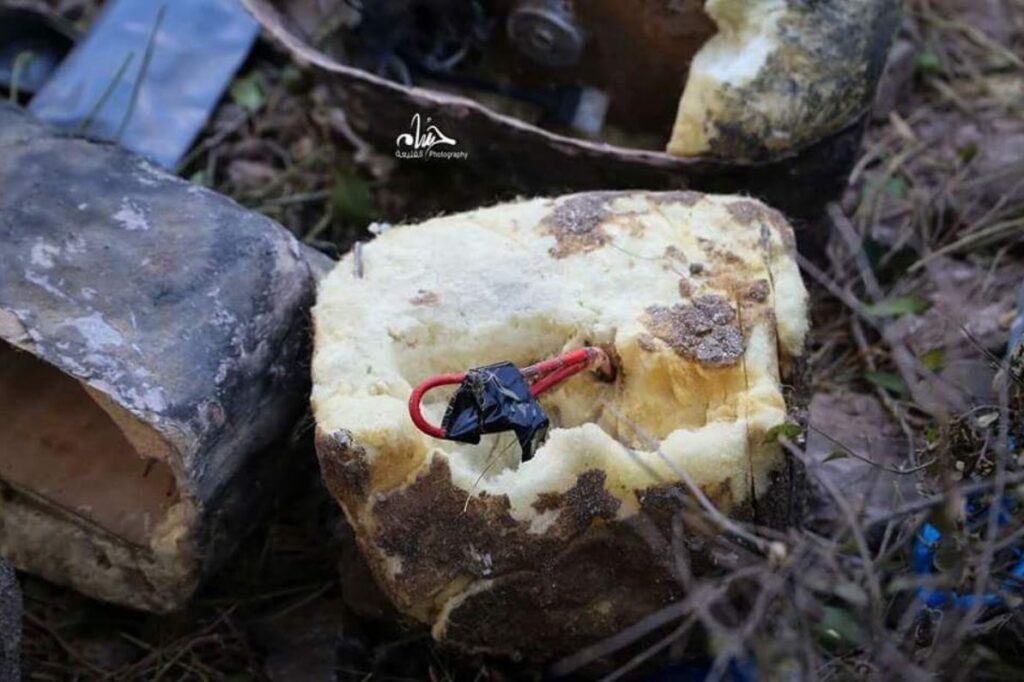
    For a vehicle travelling along a road, the outside of these “rock” IEDs are pretty hard to distinguish from regular rocks. Pairing them with PIR sensors made them dangerous to route search for also.

    The second that comes to mind is chemical detection. Right now we lack the tools to effectively recognise where gaseous chemicals have spread to without putting detectors in various places and estimating the gaps inbetween. With a hyperspectral camera it is straightforward to identify gases based on their hyperspectral fingerprint from a distance, with the usual proviso that they have IR-active groups in the bands being measured.

    This would mean HAZMAT jobs with a gaseous contaminant have to do less guess work when it comes to how they are containing and venting things, or how far a particular gas has spread. Plotting a downwind hazard after a release goes from a guess to quantifiable amount with a UAS-mounted HSI.
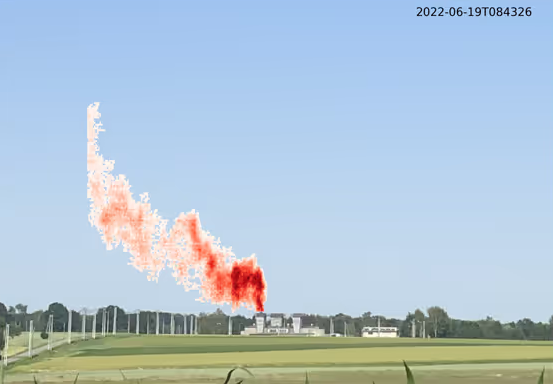
    This is an image from a Hyspex camera detecting methane emissions, colourised red. Methane is invisible to the naked eye and not actually red.

    The spectral fingerprinting I have described here is a feature of hyperspectral imaging. It is worth contrasting this with multispectral imaging which still gives some insight into the spectrum past the visible portion by showing bands of infrared. Much less study has gone into whether or not multispectral cameras are “good enough” for the purposes I have discussed above and it is worth a shot to investigate if it means more people can get access to seeing in infrared.
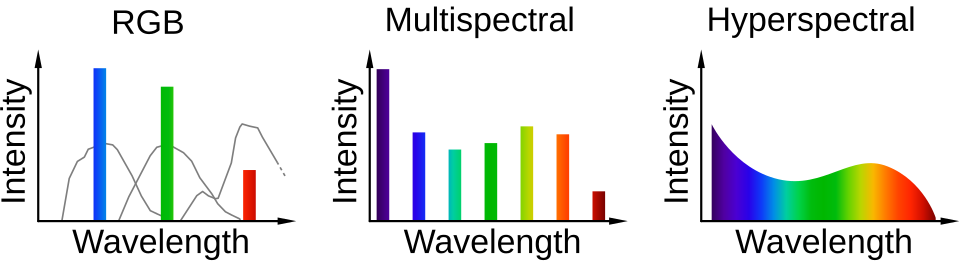
    There is already a huge jump in information from a regular RGB camera to a multispectral one. Hyperspectral is needed to really understand the continuous spectrum.

    Next time, we will have a look at what imaging systems have been studied for the kinds of defence applications discussed here. Whilst I hope I have painted a hopeful picture for the technology, and a lot of work has been done to show its efficacy right now, for CBRNE there are still a lot of employment questions left to be tackled.
  • What is that stuff? Detection Technology is a Rabbit Hole

    What is that stuff? Detection Technology is a Rabbit Hole

    If you ever come across a lab where people leave unlabelled products on a table, you may wonder what exactly it is you have found. Some things have a distinctive colour, smell, texture, but an annoyingly large number of them are white crystalline powders.

    So how do you answer the question “what is this?” I find that kind of measurement/sensor/detector technology to be endlessly fascinating. When it comes to figuring out what a substance is, the tests all revolve around figuring out some kind of feature of the substance that we can recognise. That is really vague because the tests are more vague than we sometimes give them credit for.

    A Fourier-Transfer Infrared (FTIR) based detector looks for functional groups of a substance. A gas chromatography one compares elution times which is a proxy for volatility in the gas phase. A mass spectrometer will try and identify base on the mass of fragments. A colorimetric test will usually use the target substance as a catalyst for a colour-change reaction.

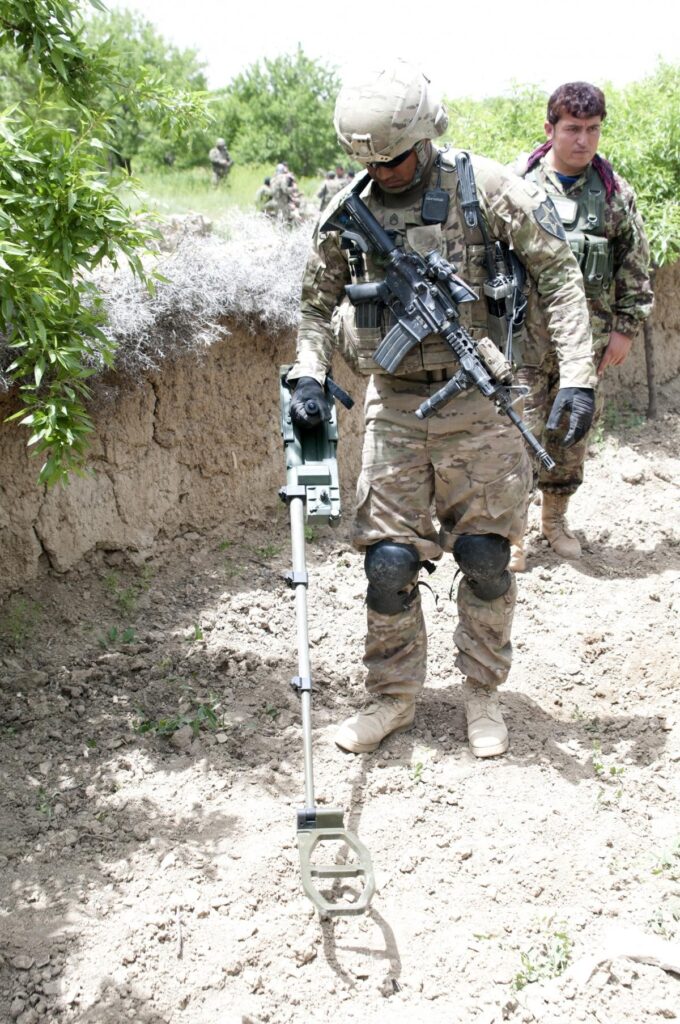
    These kinds of detectors are used to search for explosive devices by the military, but they actually cannot detect explosives at all. They detect metal and we hope that the explosive device has some metal content.

    What we would love is a rugged handheld device which we could point at anything and it could tell us what it is, regardless of its purity or nature, without destroying it, to a perfect degree of sensitivity and specificity. Certain detectors – like a Raman spectrometer – do approximate that, as long as it not a dark energetic, or too much of a mixture, or Raman inactive, and you don’t care about isotopes, etc. But even a Raman spectrum does not actually give a readout of what a substance is, it merely tells you about its (Raman active) bonds and then the library will guess as to what the molecule is. This library step can mislead the end user into believing that a Raman test is more confirmatory than it really is.

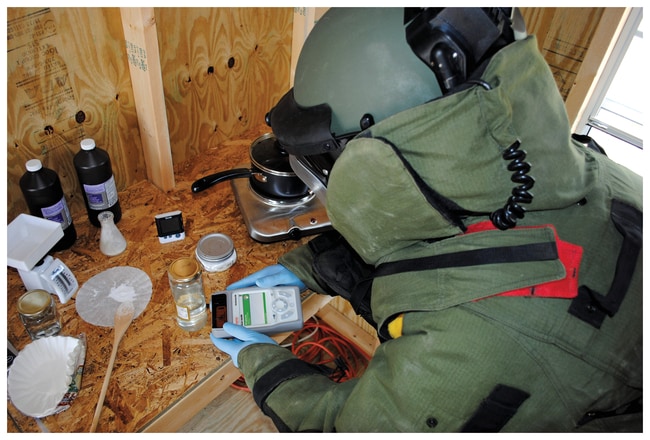
    ThermoFisher’s Raman spectrometer shown here scanning through a glass jar at an unknown liquid.

    Even if we separate our substance for purity with some kind of chromatography, get an IR spectrum to identify functional groups and a mass spectrum to identify the mass fragments, we would still not be able to distinguish confidently between isomers of compounds in all cases. These techniques ignore stereochemistry, which can be really important: the famous medication thalidomide had one isomer which helped against morning sickness and the other gave babies birth defects. The difference was the arrangement of the molecule.

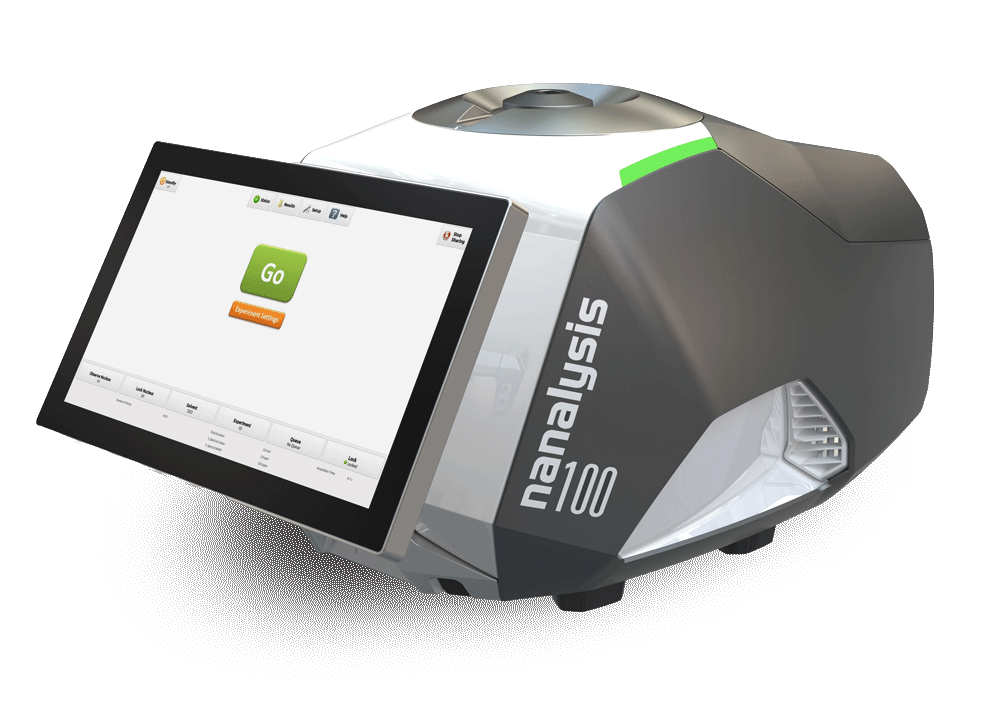
    This is a benchtop NMR machine, the most portable version of the kind of tool you would need to identify the stereochemistry of a molecule. Typical lab-grade ones can occupy whole rooms.

    The good news is that you very rarely need to know everything about a substance. Sometimes you only care if it is energetic. You may want to check for the presence of blood or a narcotic. Maybe you only care about whether or not you can breathe in a certain environment by checking for certain poisonous gases and oxygen. Being specific about what you want a detector to do is important in selecting the right tool and you then have to be conscious of its limitations.

    The Raman spectrometer mentioned before will continue to be a go-to for me, even though I can’t really sample gases effectively, and it can detonate dark energetic compounds, and it cannot see metals, or ionic acids like hydrochloric acid…I need it to be able to identify explosives, ideally without touching them, and the kinds of covalent bonds that explosives have are typically Raman active. If a trace amount of darker powder detonates, then I basically have the answer I need anyway.

    Your use case may be different in terms of the scope of compounds, the safety requirements, or the forensic sensitivity involved. It is important that you determine your needs carefully and then select the tool that best approximately what you do.

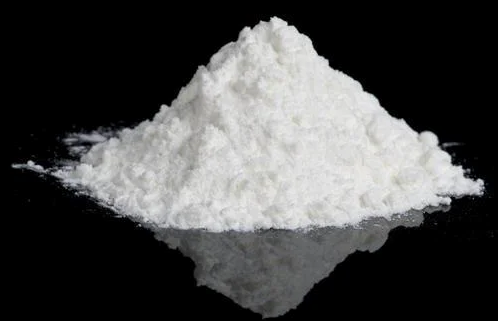
    PS: the header image is from an online advert for “white crystalline powder”, which is apparently lab grade and very pure. Unfortunately, it has no information on what it actually is so a few of these techniques would be in order.