
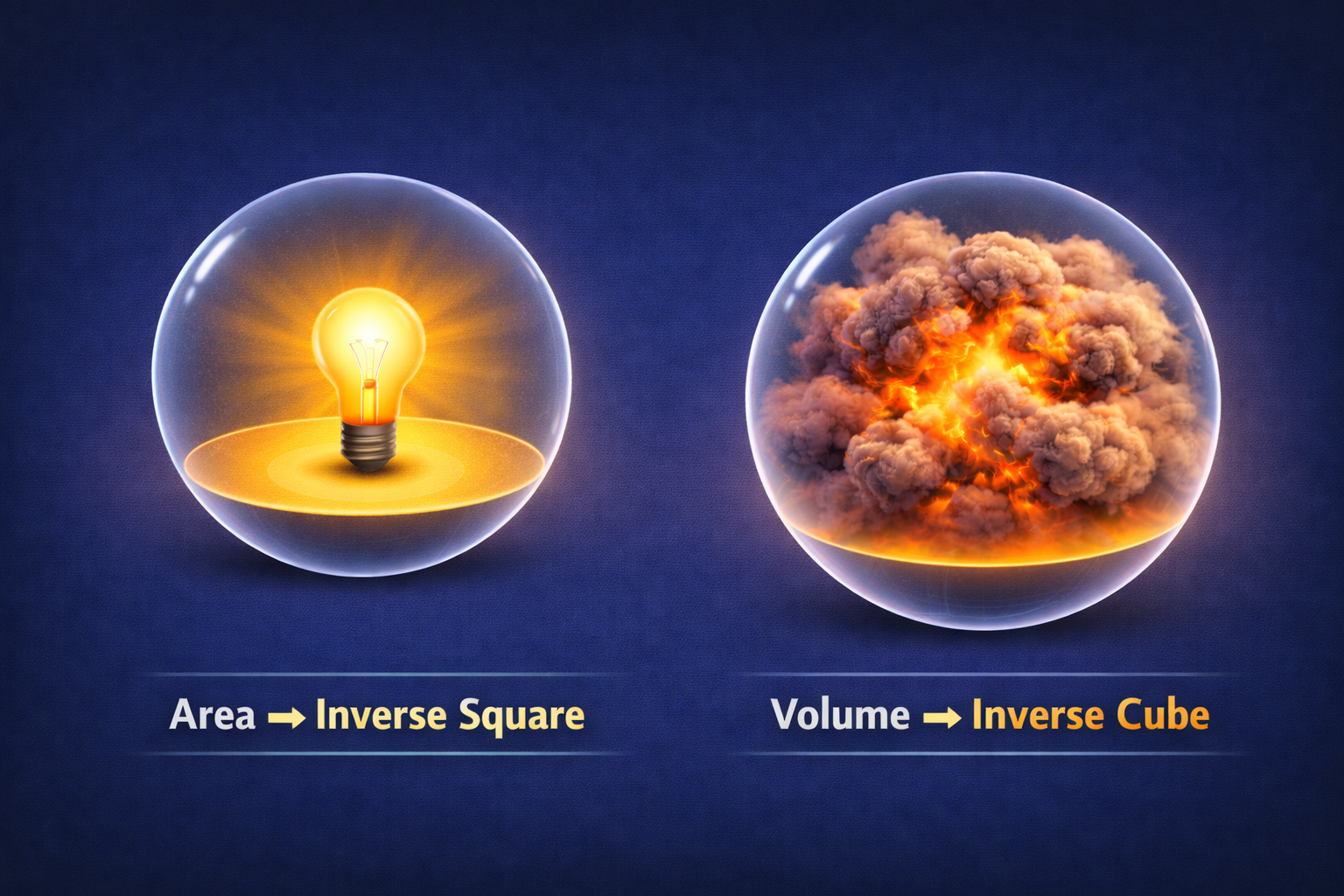
Safety calculations for different kinds of hazards involve a bit of maths that are quite intuitive if you know where they come from and seem arbitrary otherwise. In this post, we will explain where inverse square laws and inverse cube laws come from to develop that gut instinct for how far you should be from blast, radiation, etc.
The most important thing to understand in order to appreciate the distance dependence of a safety rule is how the hazard spreads. For instance, a high explosive generates a lot of hot, compressed gases that expand rapidly to form blast. These gases expand in a volume, and volume is in distance cubed (eg metres\(^{3}\)), so the safety law is associated with an inverse cube law.
When we are dealing with radioactive sources we have an inverse square law because the radioactive emissions do not fill up a volume, they instead spread out in all directions like the light from a bulb. This forms a surface with area units (eg metres\(^{2}\)).
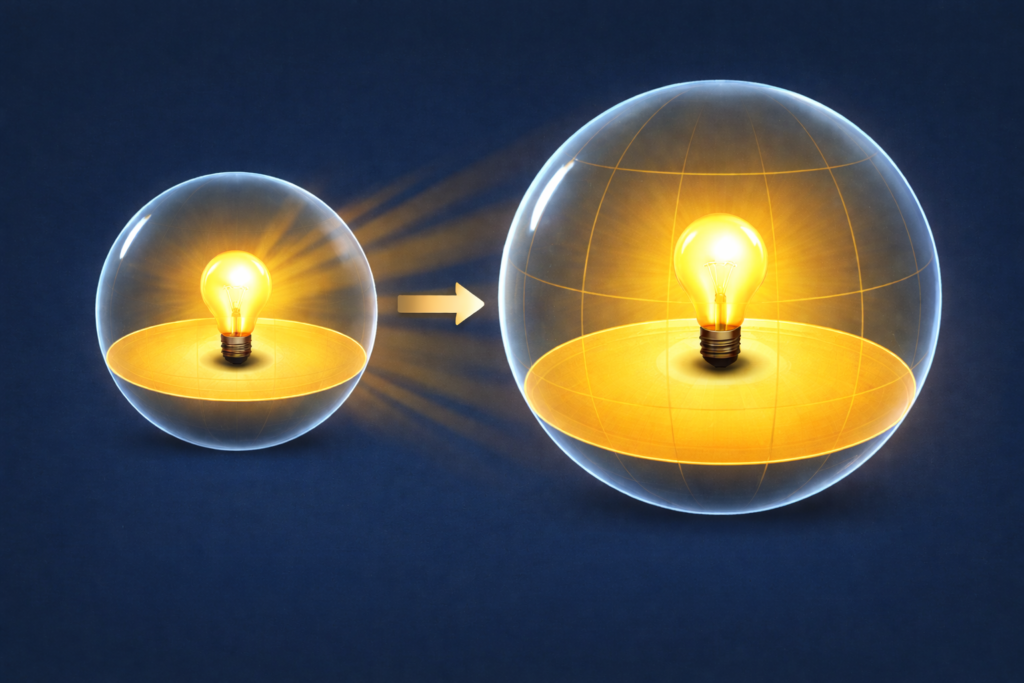
Compare the light from the light bulb – which behaves like a radiation source – to the gases from an explosion which carry the blast:
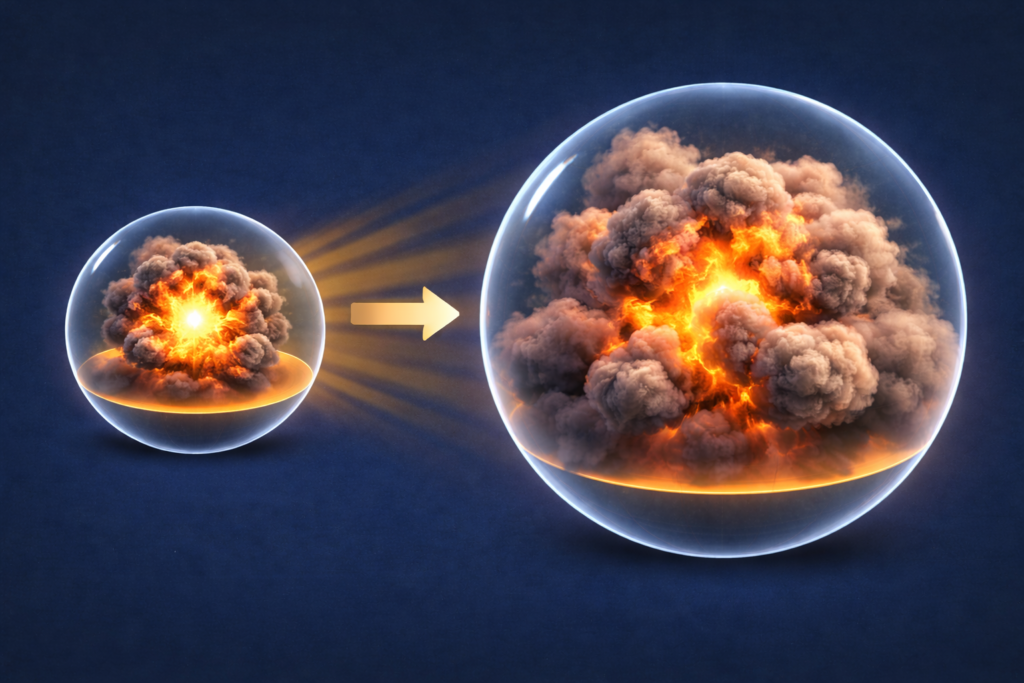
Now I appreciate that this picture is not exactly life-like, but I hope it illustrates the different way that the explosion gases expand to fill the space compared to the spread of light over a surface area. To get the inverse part of these laws we consider that the effect is spread over the area/volume.
Explosion occurs -> hot detonation gases spread outwards in all directions -> spread in a volume of \(\frac{4}{3} \pi r^{3} \), or in other words, all the gases are spread throughout the sphere means \(\frac{1}{\frac{4}{3} \pi r^{3}} \). The \(\frac{4}{3} \pi \) is just a constant, the important bit is that the safety distance will be described by a factor of \(\frac{1}{ r^{3}} \).
Radiation source emits -> radiation spreads outwards in all directions -> spread across the surface of a sphere -> \(\frac{1}{4 \pi r^{2}} \). Of course, with radiation the source is constantly emitting so that gives us a dose rate per second. To state the obvious, that is why distance, shielding, and time are mitigations for radiation whereas only distance and shielding help with blast.
So what about fragmentation distances? Fragmentation would spread evenly in all directions much like radiation and so form a “surface”, so you would think that it would have an inverse square law. In fact, in outer space it would do. On earth the limiting factor to the inverse square law for frag is that gravity drags it to the ground so it does not travel straight, and air drag slows it down so it does not travel forever. So for very close distances, fragmentation hazard distances are an inverse square law, but at the kinds of distances we care about to be safe, a more complicated relationship holds.